Saatva vs Tempur-Pedic: Is the Price Gap Actually Buying Anything?
These two mattresses are the standard recommendation at opposite ends of the market, and buyers cross-shop them constantly. The comparison is not close on price — a queen Saatva Classic and a queen Tempur-Pedic ProAdapt sit in different brackets — so the useful question is what the extra money buys and what it does not.
The structural difference in one paragraph
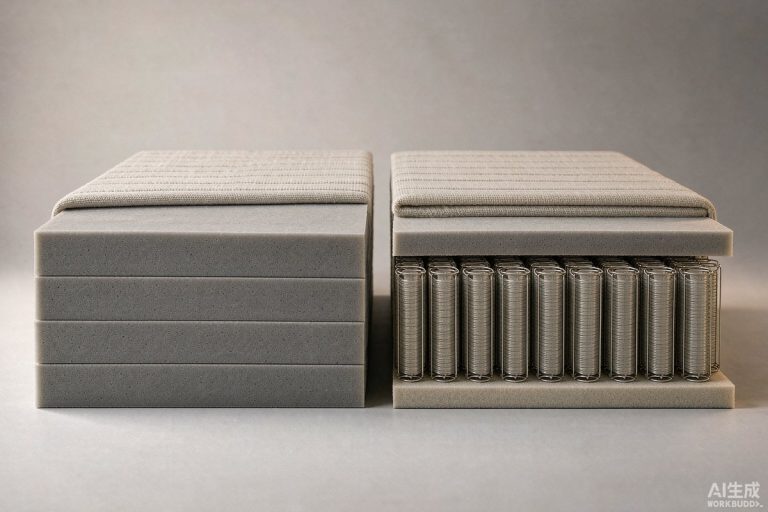
Saatva Classic is coil-on-coil: a support coil unit, a layer of pocketed micro-coils above it, a thin foam comfort layer, a quilted cotton cover. Tempur-Pedic ProAdapt is all foam: a proprietary memory foam layer over transition foam and a high-density base. Everything else in this comparison follows from that.
Coils make a surface that responds immediately and holds its shape. Memory foam makes a surface that deforms slowly and locally. Neither is better in the abstract; they solve different problems.
Head to head
| Dimension | Saatva Classic | Tempur-Pedic ProAdapt |
|---|---|---|
| Construction | Coil-on-coil hybrid | All foam, memory foam top |
| Feel | Responsive, slight bounce, sleeps “on top” | Slow-conforming, sleeps “in” the bed |
| Firmness options | Plush, Luxury Firm, Firm | Soft, Medium, Medium Hybrid, Firm |
| Heat | Cooler — foam is thin, cotton cover | Warmer — thick memory foam stores heat |
| Motion transfer | Moderate — coils pass some movement | Excellent — slow local deformation |
| Edge support | Strong — coil perimeter | Moderate — foam softens at the edge |
| Delivery | In-room, old mattress removed, included | Usually boxed or two-person, varies by retailer |
| Trial | 365 nights | 90 nights typical |
| Durability profile | Coils outlast foam; comfort foam is the weak point | Depends on foam density; memory foam can develop impressions |
What the extra money buys
Pressure relief. This is memory foam’s genuine advantage and the reason the material became famous. It distributes load across a wide area rather than concentrating it, which for a sleeper with joint pain or a bony frame can be the difference between waking stiff and not.
Motion isolation. If you share a bed with a light sleeper, the Tempur-Pedic advantage is real and large. Saatva’s coils transmit movement; memory foam absorbs it.
A distinctive feel that some people love. The slow-conforming sensation is polarising. People who like it tend to love it; people who describe it as “stuck” or “hot” never adapt.
What it does not buy
Better spinal alignment for back pain. Both designs can hold the hips level. A medium-firm Saatva and a medium ProAdapt both work for a back sleeper; the choice comes down to feel and heat, not to alignment. Our guide to mattresses for back pain covers the geometry.
A longer warranty in any meaningful sense. Both offer long warranties that exclude the failure mode you are most likely to experience — body impressions below a stated depth. The warranty length is a marketing number, not a durability measure.
Cooler sleep. This is the one place the price works against the buyer. More dense foam means more stored heat. A hot sleeper who buys the more expensive mattress is buying a warmer bed. Our comparison of memory foam versus latex explains why this is a materials property rather than a fixable feature.
Delivery convenience. Saatva includes in-room setup and old mattress removal, which is a genuine service with real cost. If you are buying because you cannot move a mattress yourself, the cheaper mattress includes something the expensive one often does not.
Who should pick which
Choose Saatva Classic if: you sleep hot, you want a responsive surface, you have back pain and want a support core rather than a conforming top, you want in-room delivery, or you want a trial long enough to cover a full year of seasons.
Choose Tempur-Pedic ProAdapt if: you have joint pain and want maximum pressure distribution, you share a bed with a light sleeper, you like the slow-conforming feel, or you are a back or side sleeper who does not overheat.
Choose neither if: you are a firm-preferring stomach sleeper (Saatva’s Firm is a better fit than any ProAdapt) or you are shopping on price — a mid-range hybrid does much of what both of these do.
The compromise option worth naming
The reason this comparison is harder than it looks is that the middle of the market has closed the gap. A firm hybrid with a dense comfort layer gets most of Saatva’s support and most of Tempur-Pedic’s isolation at a lower price, giving up some durability and the delivery service. If neither of the two headline options is an obvious fit, that is where to look rather than picking the more expensive one by default.
Setting up around either mattress
The mattress is the base layer. Two additions change the experience more than the price bracket does:
A pillow matched to your sleeping position — our neck pain pillow guide covers loft by position, and a wrong pillow undoes a good mattress.
A cooling topper for the Tempur-Pedic if you sleep hot — with the caveat in our cooling topper guide that surface cooling is finite and room temperature matters more.
FAQ
Is Tempur-Pedic worth twice the price of Saatva? For a side sleeper with joint pain who shares a bed with a light sleeper, the argument is strong. For a hot-sleeping back sleeper, the cheaper mattress is the better technical fit.
Does memory foam soften or harden over time? It softens, and then it collapses. The initial softening is normal and happens within weeks; the collapse is a density problem and shows up as a body impression.
Can I use a Saatva on an adjustable base? Yes, the Classic is compatible with adjustable bases.
Which is better for a heavy sleeper? Saatva’s coil core resists compression better than foam does. Above roughly 250 lb, the coil construction is the safer bet structurally, though the comfort foam remains the weak point in both.
Is the 365-night trial real? It is a genuine policy with conditions — a minimum trial period before you can return, and return shipping may apply. Read the terms rather than the headline.
For anything involving diagnosed pain or a sleep disorder, see our medical disclaimer; a mattress is not a treatment.