Best Yoga Mats for Home Practice (2026): Thickness, Grip, and the Material Trade-Off
A yoga mat is the most over-discussed and under-specified piece of home fitness equipment. The two numbers that matter are thickness and material, and the marketing leads with colour, “eco” claims, and alignment lines.
Thickness is a joint decision
Mat thickness trades off two things: cushioning and stability.
| Thickness | Suits | Trade-off |
|---|---|---|
| 1.5–3 mm | Vinyasa, balance work, travel | Almost no joint protection; knees and wrists feel the floor |
| 4–5 mm | General home practice — the default | Adequate cushion, still stable |
| 6 mm | Beginners, gentle and restorative practice | Balance poses get harder; standing poses feel unstable |
| 8–10 mm | Kneeling and floor work, pilates, seated practice | Too unstable for standing balance poses |
| 12 mm+ | Padding over hard floors, injury recovery | Not a yoga mat; a floor pad |
Two rules of thumb that resolve most of the choice:
- Thicker is harder for balance. Standing balances and single-leg work rely on proprioceptive feedback from the foot; a soft surface blurs it. If your practice includes balance, do not go above 6 mm.
- Knees and wrists drive the minimum. If kneeling poses hurt, the fix is usually a thicker mat plus a separate knee pad — not a 10 mm mat that ruins your standing poses.
For most people the answer is 4 to 5 mm and, if knees are an issue, a small square knee cushion used where needed.
Grip is a moisture question
“Non-slip” on a product page usually means “textured.” What determines grip is how the surface behaves when your hands are damp.
- PVC and TPE (the closed-cell foams) are grippy when dry and become slippery when wet. They are the standard for hot yoga only if you add a towel.
- Natural rubber (often marketed as “tree rubber”) has better wet grip and more cushion rebound. It is heavier and has a distinct rubber smell that fades.
- Polyurethane (PU) top layers are the best wet grip available and are what most hot yoga mats use. They are also the most expensive top surface and can be marked by oil from skin.
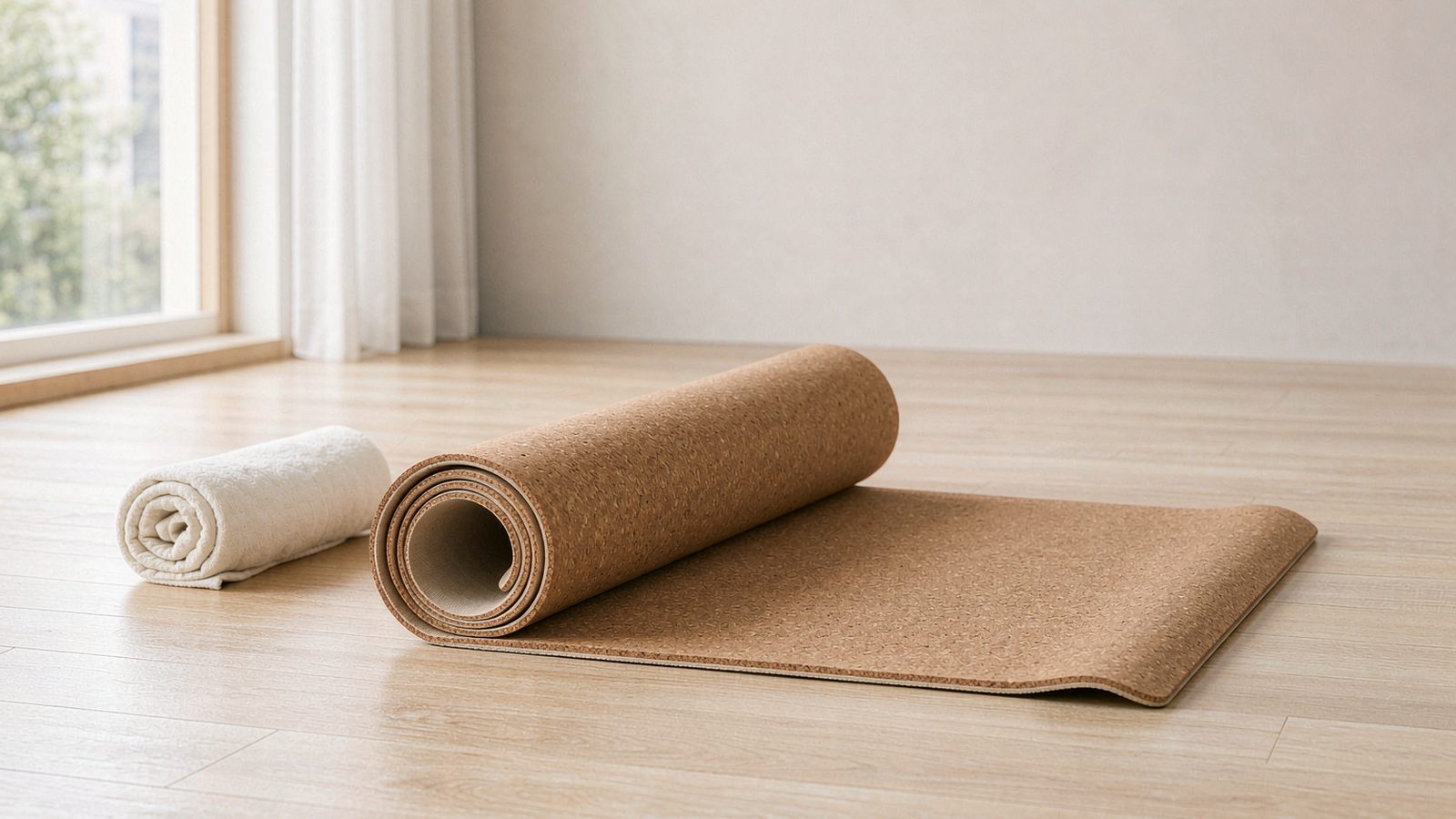
- Cork has excellent dry grip and good wet grip — cork becomes tackier when slightly damp, unlike foam — but it is thin, hard, and needs a rubber base to stay put. Cork over a rubber base is a genuinely good combination for sweaty practice.
- Microfibre top is the towel-and-mat combination in one; it must be dampened before use to grip.
If your hands sweat, buy for wet grip. If they do not, any decent textured mat will do and the extra money buys durability rather than grip.
Materials, and the “eco” claims
| Material | Durability | Grip (dry / wet) | Notes |
|---|---|---|---|
| PVC | Very good | Good / poor | Most durable; not recyclable; contains plasticisers |
| TPE | Moderate | Good / poor | Lighter, less durable, degrades faster |
| Natural rubber | Very good | Very good / good | Heavy; rubber smell; latex allergy |
| PU top on rubber base | Very good | Good / excellent | Best wet grip; highest cost |
| Cork on rubber base | Good | Good / very good | Firm; naturally antimicrobial; heavy |
| Cotton / jute | Low | Moderate / poor | Traditional; not for sweaty practice |
| Microfibre top | Moderate | Good when damp | Needs wetting; machine washable |
“Biodegradable” and “eco-friendly” TPE claims are common and hard to verify. A more useful indicator is whether the manufacturer names the material and its proportion, and whether the mat has a real odour problem out of the box — strong chemical smell usually indicates plasticiser content that will off-gas for weeks.
Latex allergy is a genuine exclusion for natural rubber mats. Look for latex-free labelling if that applies.
Grip on the floor, not just under your hands
A mat that slides on the floor is a fall risk, and this is a floor problem rather than a mat problem.
- Hardwood and laminate: a smooth-backed mat will slip. Look for a mat with a textured or rubber underside, or use a thin non-slip rug pad underneath.
- Tile: as above, and worse when damp. Same solution.
- Carpet: mats generally grip better, but a soft pile makes balance work unstable. A firm, low-pile carpet is best; on deep pile, put a thin hardboard or a firm mat underneath.
- Concrete or a garage floor: cold and unforgiving. A thicker base is justified here.
Care, which determines lifespan
- Closed-cell foams (PVC, TPE): wipe with a damp cloth and mild soap; do not soak. Dry fully before rolling, or the closed cells trap moisture and the mat develops a smell.
- Open-cell and PU surfaces: these absorb sweat by design and need a proper cleaner, not just water. Follow the manufacturer’s product; alcohol degrades PU.
- Natural rubber: keep out of direct sun, which perishes the rubber. Store rolled, not folded — folds become permanent creases that never flatten.
- Cork: wipe with a damp cloth; do not soak. Cork is naturally antimicrobial, which is a real advantage if you leave the mat out.
- Sun exposure degrades every material. Leaving a mat in a hot car will shorten its life dramatically regardless of price.
What to look for
| Feature | Target | Why |
|---|---|---|
| Thickness | 4–5 mm for general practice | Balance versus joint comfort |
| Weight | Under 2.5 kg if you carry it | Rubber mats are heavy |
| Dimensions | At least 183 × 61 cm; 200 cm if tall | Short mats put knees off the edge |
| Wet grip | Stated, if you sweat | The most common failure |
| Backing | Textured or rubber | Prevents sliding on hard floors |
| Material | Named, with proportion | “Eco” alone is not informative |
| Latex | Latex-free if allergic | Natural rubber is a latex product |
| Roll | Rolls tightly, stays flat | A mat that curls at the edges is a trip hazard |
| Care instructions | Specific, not “wipe clean” | PU and cork need different care |
Length is worth checking properly. Standard mats are 183 cm; if you are over about 180 cm, a 200 cm mat prevents your feet and head from landing off the mat in supine poses, which is a small thing that becomes annoying daily.
How we assessed this
For recovery and ergonomic hardware we compare construction and material specification, published pressure or vibration data where the maker supplies any, warranty length measured against the use the product is sold for, and owner reports on the failure mode specific to the category: motor noise on massage guns, cell degradation on battery devices, compression set on foam.
We also weigh the boring variables that decide whether a device gets used at all: setup time, noise, where it lives when it is not in use, and whether it needs an app. A recovery tool you skip because it takes four minutes to set up has a compliance rate of zero.
What we cannot verify: we have not used every device here hands-on, and we do not measure muscle recovery. Claims that a consumer device flushes lactate or accelerates tissue repair are not supported by independent evidence for these products, so we do not repeat them; where the plausible benefit is comfort or circulation during use, we say that instead. No brand pays for placement.
The rules behind this section — how picks are made, what we disclose, and how corrections are handled — are written down in our editorial policy. If a pick here looks wrong to you, that page tells you how to tell us.
FAQ
Is a thicker mat better for knees? It helps, but the better fix is a separate knee pad used only for kneeling poses. A 10 mm mat makes balance work noticeably harder.
PVC or TPE? PVC lasts longer and grips better dry; TPE is lighter and marketed as more recyclable. Neither has good wet grip.
Why does my mat slide on my floor? Almost always the floor. Add a thin non-slip pad underneath, or choose a mat with a rubber backing.
How often should I replace a mat? When the surface is shiny and slick where your hands go, or when it no longer lies flat. Closed-cell mats typically last two to five years of regular practice.
Can I clean it with alcohol? Not PU surfaces, and not regularly on any of them. Mild soap and water is the safe default.
Do I need a mat at all? For floor-based practice, yes — the cushioning and grip both matter. For standing-only practice on carpet, a towel is often enough.