Best Office Chairs for Back Pain (2026): Adjustments That Matter, and the Ones That Do Not
Office chairs are sold on materials, aesthetics, and a list of adjustment points. Back pain is affected by four of them. The rest — headrest, tilt tension, “ergonomic mesh” — matter far less than whether the chair fits your seat depth and whether you get out of it regularly.
The honest framing first
No chair has been shown to cure back pain. What the evidence supports is narrower: a chair that fits reduces the sustained load on the lumbar spine, and position variety reduces discomfort more than any single chair.
Two things follow. First, a mid-priced chair set up correctly beats an expensive one set up wrong. Second, the chair is one input among several — desk height, monitor position, and how often you stand all interact with it.
The four adjustments that matter
1. Seat height. Feet flat on the floor, knees at roughly 90 degrees, thighs roughly horizontal. If your desk is a fixed height, compromise in this order: lower the seat to the desk, then add a footrest if your feet leave the floor. A dangling foot is worse than a slightly high desk.
2. Seat depth. The front edge of the seat should sit 2 to 5 cm behind the back of your knee, so you can slide a hand behind the calf. Too deep puts pressure behind the knee and pulls you into a slouched pelvic position; too shallow leaves the thighs unsupported. This is the adjustment most often missing — a seat-depth slider or a seat-depth-adjustable sliding mechanism is worth paying for, and it is the reason a chair that fits a 6’2″ user will not fit a 5’4″ one.
3. Lumbar support height. The support should sit in the lumbar curve — the inward curve above the pelvis, roughly at belt height and a little above, not in the mid-back. Adjustable lumbar height is genuinely useful; a fixed lumbar pad placed by the designer’s guess is often 5 cm too high or too low. Depth adjustment matters too: it should touch the curve without pushing you forward off the seat.
4. Armrests. Adjust so the arms rest lightly with the shoulders relaxed, elbows at 90 degrees. Armrests should go low enough to slide under the desk, and should be adjustable in height and width — a fixed armrest that hits the desk edge forces you to sit further back, which breaks the seat-depth setting you just made. 4D armrests (height, width, depth, angle) are worth it for anyone with shoulder or neck symptoms.
Two secondary settings: seat tilt should be neutral or slightly forward for most people, and backrest recline should have a tension setting that lets you lean back a few degrees without fighting it. A locked 90-degree backrest is not better for the spine; a slight recline reduces disc pressure.
| Adjustment | Target | If you cannot adjust it |
|---|---|---|
| Seat height | Feet flat, knees ~90° | Add a footrest, do not dangle |
| Seat depth | 2–5 cm behind the knee | Add a lumbar cushion to reduce effective depth |
| Lumbar height | Belt height, in the lumbar curve | Choose a chair with height-adjustable lumbar |
| Lumbar depth | Contact without pushing | A strap-on cushion is a workable substitute |
| Armrest height | Shoulders relaxed, elbows 90° | Remove armrests rather than sit poorly |
| Armrest presence | Slides under the desk | Check the desk edge height first |
| Recline | Slight, unlocked | Locked upright is worse for discs |
| Headrest | Optional | Only matters if you recline |
The features that are sold hard and matter less
Mesh versus foam. Mesh breathes better; foam conforms more. Neither is better for back pain, though a good mesh seat distributes pressure well and does not compress over years the way cheap foam does.
“Ergonomic” curves moulded into the backrest. A fixed curve assumes a fixed spine. Adjustability beats sculpting.
Headrests. Useful only if you actually recline. On an upright chair they push the head forward, which is the opposite of what you want.
Weight rating and “big and tall” sizing. These matter practically: a chair rated for 150 kg has a wider seat and a stronger gas lift. If you are above about 100 kg, check the gas-lift class (Class 4 is the strongest) and the seat width, because a narrow seat concentrates pressure at the hips.
Certification. BIFMA (North America) and EN 1335 (Europe) are real durability and dimension standards. A chair that passes EN 1335 Type A is dimensionally suitable for 8-hour use. This is a more useful signal than most marketing claims.
The thing that matters more than the chair
Sitting in a perfect chair for eight hours is still eight hours of static load. The interventions with better evidence than any chair purchase:
- Stand and move every 30 to 45 minutes. Two minutes is enough. A timer is more effective than willpower.
- Change position deliberately — recline, perch forward, cross a leg, stand. Variety in loading is protective.
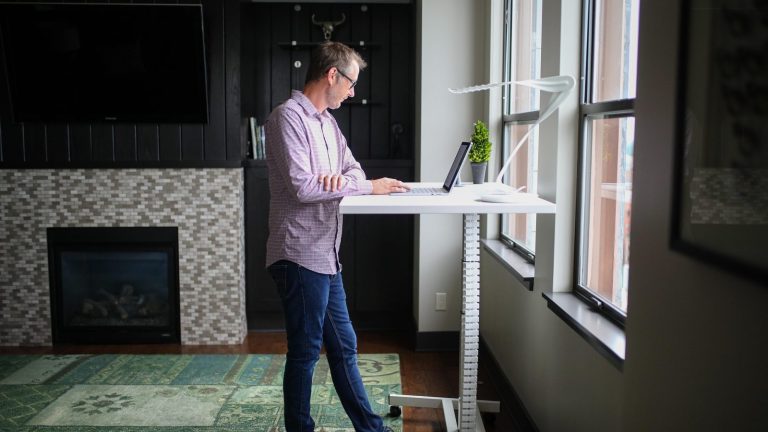
- A standing desk is the easiest way to make the change structural. Our standing desk guide covers sizing it to your body.
- A lumbar cushion can rescue a chair that is otherwise fine. Our lumbar support guide covers which shapes work and which push you forward.
- Strength work — particularly hip hinge patterning, glute and trunk endurance — has better evidence for chronic low back pain than any seating intervention. This is the least commercial advice in this article and the most likely to help.
When back pain is not a chair problem
See a clinician rather than shopping if you have:
- Pain radiating below the knee, with numbness or weakness
- Loss of bladder or bowel control, or saddle numbness (this is an emergency)
- Pain that wakes you at night and does not change with position
- Unexplained weight loss alongside back pain
- Pain following a fall or impact
A chair is a comfort intervention. It is not a treatment for a structural problem.
What to look for
| Feature | Target | Why |
|---|---|---|
| Seat depth adjustment | Yes, sliding seat pan | Determines whether the chair fits your leg length |
| Lumbar | Adjustable height and depth | Fixed pads are usually in the wrong place |
| Armrests | Height and width adjustable, or removable | Must fit under the desk |
| Seat height range | Covers your seated height with a footrest option | Short and tall users need different ranges |
| Recline | Unlocked, adjustable tension | Reduces disc pressure |
| Gas lift | Class 4 for heavier users | The part that fails |
| Certification | BIFMA or EN 1335 | Independent durability standard |
| Warranty | 5+ years on the mechanism, not just the frame | Mechanisms and gas lifts fail |
| Returns | Try-before-commit, or a return window | Fit is individual; buy where you can send it back |
FAQ
Is a $1,000 chair worth it over a $300 one? Above the mid-range you are buying adjustability range, durability, and warranty. If a $300 chair has adjustable seat depth, adjustable lumbar, and fits you, the extra money buys longevity rather than comfort.
Should I sit on a stability ball instead? No. The evidence shows no benefit for back pain and higher fall risk. It is a variety tool at best.
Is a kneeling chair better? It changes the hip angle and reduces lumbar flexion, which some people find helpful and others cannot tolerate for long. It is not a general improvement.
How long should I sit before standing? 30 to 45 minutes is the usual guidance, but the more reliable rule is: change position before discomfort starts, not after.
Do I need a footrest? Only if your feet do not reach the floor at the correct seat height. If they do, a footrest changes the angle without benefit.
Will a cushion fix my chair? It can fix lumbar placement and seat firmness. It cannot fix insufficient seat depth, a seat that is too high, or a backrest that does not recline.