Why Your Partner’s Snoring Wakes You (and What Actually Helps)
Snoring is the most common sleep complaint in couples and the one with the worst ratio of advice to evidence. “Just wear earplugs” is the standard response, and it is roughly as useful as telling someone to sleep through a smoke alarm.
Why it wakes you and not them
Snoring is turbulent airflow through a partially obstructed upper airway, producing vibration in the soft palate and pharyngeal walls. The sound is generated on inspiration, typically in the 40 to 90 dB range for a heavy snorer — comparable to a conversation or a vacuum cleaner depending on severity and distance.
Three things determine whether it wakes you:
Your sleep stage. Arousal thresholds are much lower in light sleep (N1, N2) than in deep sleep or REM. This is why you can sleep through snoring at 2 a.m. and be woken at 5 a.m., when light sleep dominates.
The intermittency. Noise that varies in volume and rhythm is far more disruptive than steady noise at the same average level. Snoring pauses, resumes, and changes pitch. This is the same reason a dripping tap wakes people and a fan does not.
Your own sleep debt. If you are already short on sleep, you are both more likely to be woken and less able to get back to sleep.
The consequence is worth stating plainly: the bed partner of a heavy snorer can lose 30 to 60 minutes of sleep a night and accumulate significant sleep debt, with measurable effects on daytime sleepiness and mood. This is a real health issue, not an irritation.
What actually reduces the noise
Ranked roughly by effect size, not by ease:
1. Treat the snorer’s nose and airway. Snoring caused by nasal obstruction — congestion, allergy, a deviated septum, chronic rhinitis — responds to treating the obstruction. Nasal strips and internal dilators produce small objective improvements and larger subjective ones; they work best for people whose snoring originates at the nose. Saline irrigation and allergy control are unglamorous and often effective.
2. Change sleep position. Supine sleeping is worse for almost every snorer, because gravity pulls the tongue and soft palate back. Positional therapy — a body pillow against the back, or a positional device — reduces supine time and can substantially reduce snoring. Our guide to sleep positions covers the mechanics.
3. Reduce alcohol and sedatives in the evening. Alcohol relaxes the pharyngeal muscles and raises arousal threshold. Even moderate evening drinking worsens snoring measurably. Sedatives, including some antihistamines, do the same.
4. Weight. Weight loss reduces snoring for many people, and it is the intervention with the best evidence for obstructive sleep apnoea. It is also slow, which is why it gets mentioned last in marketing and first in guidelines.
5. Oral appliances. Mandibular advancement devices — custom-fitted by a dentist — pull the lower jaw forward and open the airway. These are genuinely effective for mild to moderate obstructive sleep apnoea and for primary snoring, and they are the main alternative to CPAP for people who cannot tolerate it. Off-the-shelf boil-and-bite versions are less effective and can cause jaw problems; a proper fitting matters.
6. Surgery. Reserved for specific anatomical problems — tonsillar hypertrophy, septal deviation, specific palate anatomy. Success rates vary widely and it is not a general solution.
7. What does not work well. Anti-snoring sprays and pills, “smart” pillows, chin straps for most people, and most of the consumer electronics category have little or no supporting evidence. A vibrating wrist device that prompts position change has some support; almost everything else in that aisle does not.
What the non-snoring partner can do
Earplugs, properly fitted. Foam earplugs can reduce noise by 20 to 30 dB when inserted correctly — which almost nobody does. Roll, insert, hold for 30 seconds. Our earplugs guide covers NRR ratings and the fact that actual attenuation is roughly `(NRR − 7) ÷ 2` in real use. Silicone and moulded plugs are more comfortable and less attenuating.
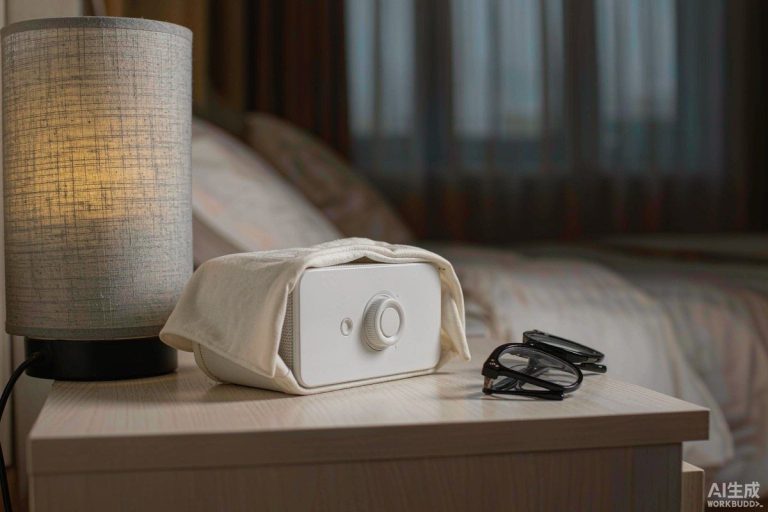
Continuous noise to mask the intermittency. A fan, a white or pink noise machine, or a dedicated masking device raises the background level so that individual snoring peaks do not cross your arousal threshold. Masking works on the intermittency problem, which is why it helps more than its decibel contribution suggests.
Two duvets, one bed. A surprising amount of night waking in couples is movement and temperature, not sound. Separate bedding removes a common trigger.
Separate sleep surfaces, deliberately. Sleeping in another room is treated as a failure and is often the most effective intervention available. The evidence on sleep and relationship quality points the other way from the stigma: sleep quality improves, daytime irritability drops, and couples generally function better. There is no requirement that good partners share a mattress.
A scheduled split. Some couples sleep together until the snorer’s worst period (often the early hours) and separate for the remainder. This preserves closeness and sleep.
When snoring needs a medical look
Snoring is a symptom. The thing worth screening for is obstructive sleep apnoea (OSA), which is common, under-diagnosed, and carries cardiovascular consequences.
Signs that a medical assessment is warranted:
- Witnessed pauses in breathing, or gasping or choking awakenings
- Loud snoring every night, especially with a partner reporting restlessness
- Excessive daytime sleepiness — falling asleep while reading, watching TV, or driving
- Morning headaches, dry mouth, or sore throat
- Waking unrefreshed despite 7 to 8 hours in bed
- High blood pressure that is hard to control, or atrial fibrillation
- A neck circumference above about 43 cm (17 in), or a BMI in the obese range
An overnight home sleep test or a laboratory polysomnography study is the appropriate next step. A consumer wearable that reports “breathing disturbances” is not a diagnosis but is a reasonable prompt to get one — our fitness tracker versus sleep tracker guide explains why.
Treating OSA — with CPAP, an oral appliance, or in selected cases surgery or weight loss — usually reduces snoring dramatically. This is the case where the “what helps the snoring” question and the “what helps the snorer’s health” question have the same answer.
FAQ
Is snoring dangerous? Simple snoring is not, but it is often the audible part of sleep apnoea, which is associated with hypertension, cardiovascular disease, and daytime accident risk. It should be assessed if any of the signs above apply.
Do anti-snoring mouthpieces work? Custom-fitted mandibular advancement devices do, for mild to moderate OSA and primary snoring. Over-the-counter boil-and-bite versions are less effective.
Do nasal strips work? They help a subset — people whose snoring originates from nasal obstruction. The effect is small but real for them.
Can I train myself not to snore? Positional change and treating nasal obstruction are the trainable parts. There is no reliable exercise protocol.
Is sleeping in separate rooms bad for a relationship? The evidence does not support that. Sleep quality and daytime mood generally improve, and couples can maintain closeness deliberately.
Does background noise help? Yes, because it addresses the intermittency rather than the volume. A fan or noise machine at 45 to 50 dB is often enough.