How Long Until a New Mattress Stops Off-Gassing (2026)
A new mattress smells of something for days to weeks. The smell is not imaginary, it is not toxic in the way alarmist articles suggest, and it does not always go away as fast as the salesperson says.
What is actually being released
The odour comes from volatile organic compounds (VOCs) released by the polyurethane foam, the adhesives, the flame retardants, and the fabric treatments. The main compounds found in mattress emission studies are:
- Toluene diisocyanate (TDI) residues from foam manufacture — the classic “new foam” smell
- Various aldehydes and ketones — formaldehyde at low levels, acetaldehyde, acetone
- Styrene from some latex and synthetic latex blends
- Flame retardants, which are semi-volatile and off-gas slowly
- Plasticiser and solvent residues from adhesives
Concentrations are highest in the first hours and days and decay roughly exponentially. Emission testing generally finds that the majority of VOCs are released within the first 72 hours, and that levels fall to a small fraction of the initial value within two weeks.
Context matters: the emission levels measured in mattress studies are typically well below occupational exposure limits and comparable to or lower than new furniture, carpets, and paint. The smell is a nuisance more often than a health hazard — but “nuisance” is not nothing, and a minority of people are genuinely sensitive.
Realistic timelines by material
| Material | Noticeable smell | Mostly gone | Notes |
|---|---|---|---|
| Memory foam (polyurethane) | Strongest, immediately | 3–14 days | Depends on foam density and whether it was compressed/rolled |
| Polyurethane foam core with fibre top | Moderate | 3–7 days | Most of the smell is the core foam |
| Natural latex | Mild, rubber-like | 3–10 days | Different odour; not VOC-heavy in the same way |
| Blended / synthetic latex | Moderate | 1–2 weeks | Styrene-related odour |
| Pocket spring with foam comfort layer | Moderate | 3–10 days | Foam layers dominate |
| All-cotton or wool | Minimal | 1–3 days | May smell of lanolin or natural fibre oils |
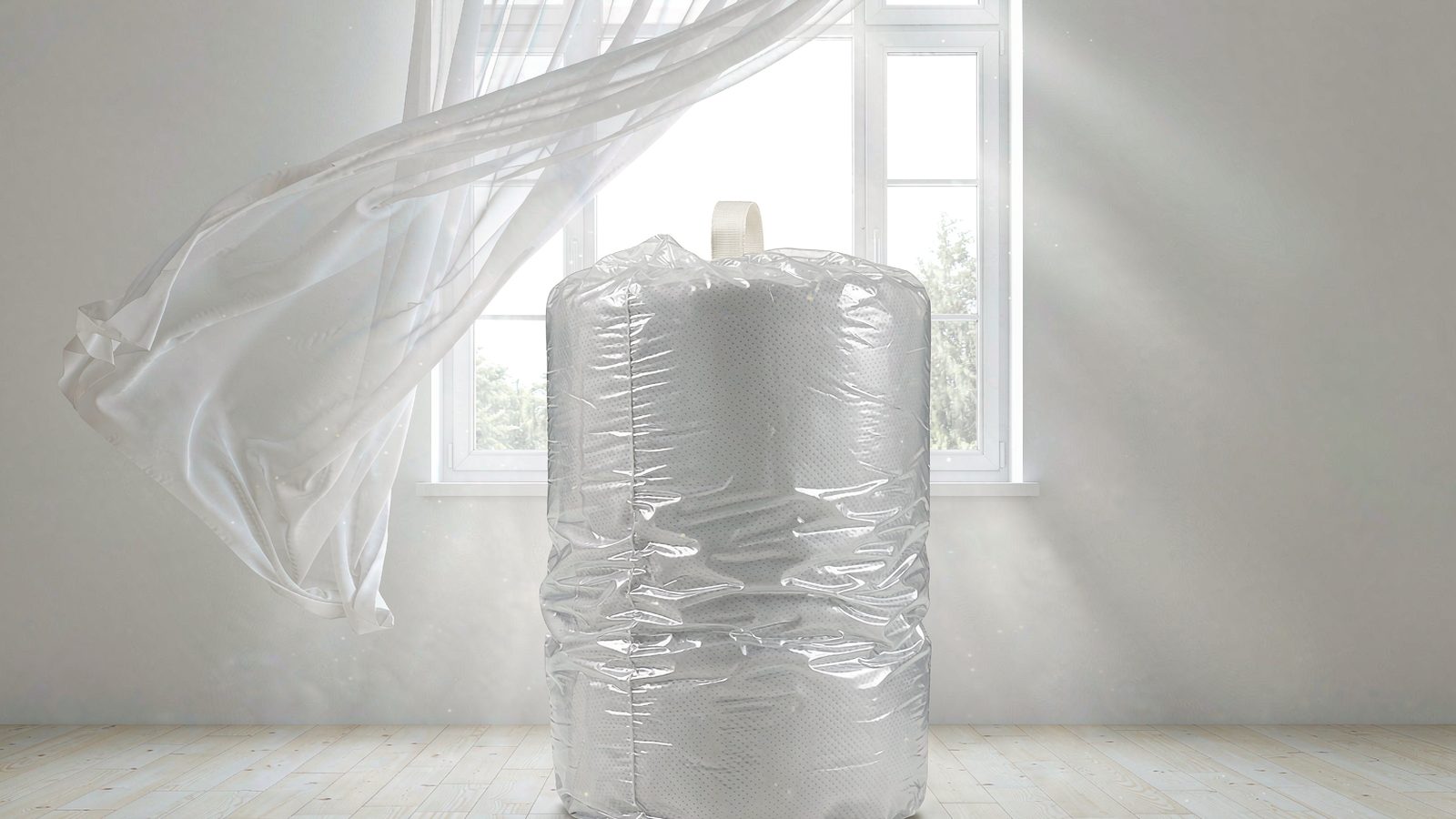
| Mattress in a box (compressed) | Strongest, because fresh surfaces | 1–3 weeks | Vacuum-sealed foam releases more on opening |
Two patterns worth noting:
- Bed-in-a-box mattresses smell more at first, because compression and vacuum packing trap emissions until opening, and the foam has had less time to air at the factory.
- Higher-density foams generally off-gas for longer, because they contain more material and the interior releases slowly. Cheap low-density foam smells worse initially but finishes sooner.
The 30-day figure that some retailers quote is a safe upper bound, not a typical experience. Most mattresses are substantially better by two weeks. If a mattress still smells strongly at four weeks, that is unusual and worth a warranty conversation.
How to speed it up
The process is diffusion, so the variables are airflow, temperature, and surface area.
- Unbox and unwrap immediately, and remove all plastic within the first hour. Keeping it wrapped “until the room is ready” is the single biggest delay.
- Put it in a well-ventilated room — open windows, a fan moving air across the surface, door open. Air changes per hour is the key variable.
- Raise the room temperature if you can. Warmer air holds more vapour and diffusion is faster. A 25 °C room with airflow clears a mattress considerably faster than a 15 °C one. (This is the opposite of what you want for sleeping in it, so do this before you start using it.)
- Prop it on its side for a few hours a day if the construction allows — more surface area exposed. Check the manufacturer’s guidance first; some foam mattresses should not be bent or stood on edge for long periods.
- Vacuum the surface with an upholstery attachment. It removes surface residues and moves air through the cover.
- Do not cover it with a waterproof protector until the smell has gone. A protector traps the emissions under a plastic layer and slows the process dramatically.
- Wash the cover if it is removable. Much of the smell lives in the fabric.
A realistic expectation: 3 to 7 days of active ventilation reduces the smell substantially; two weeks clears it for most people.
What not to do
- Do not use heat directly on the mattress — a heater or a hot car. Foam can deform, and some covers shrink.
- Do not seal it in a plastic bag to “contain” the smell. It will come back the moment you open it, and moisture may develop.
- Do not spray it with fragrance or disinfectant. It masks the odour and adds compounds rather than removing them.
- Do not assume a natural mattress cannot off-gas. Natural latex has its own odour, and wool and cotton are often treated.
When to be concerned
The smell is usually a nuisance. See a doctor if, after sleeping on the new mattress, you develop:
- Persistent headache or nausea that resolves when you are away from the bedroom
- New wheezing, cough, or shortness of breath
- Rash or contact dermatitis at areas in contact with the mattress
- Eye or throat irritation that recurs nightly
Anyone with asthma, chemical sensitivity, or a diagnosed VOC sensitivity should ventilate for longer before first use, and may want to consider a mattress with fewer foam layers.
There is no established link between mattress off-gassing and cancer at the exposure levels measured in homes, but the evidence base is thin precisely because long-term low-level exposure is hard to study. The reasonable position is: ventilate well, do not worry excessively, and if you are symptomatic, act on the symptoms rather than the label.
What to look for
| Feature | Target | Why |
|---|---|---|
| Certifications | CertiPUR-US (foam), GREENGUARD Gold (emissions) | Independent limits on foam content and VOC emissions |
| Foam layers | Fewer, and higher quality | More layers, more adhesive, more emissions |
| Cover | Removable, washable | Removes a share of the smell |
| Adhesives | Water-based if stated | A major emission source |
| Delivery timing | Order when you can ventilate for a week | Logistics, not specification |
| Return policy | Note whether odour is a valid return reason | Some policies exclude “smell” |
GREENGUARD Gold is the most directly relevant certification here: it sets limits on total VOC emissions for the finished product in a modelled indoor environment, which is exactly the question being asked. CertiPUR-US addresses foam content and emissions from the foam itself. Neither guarantees no smell — a certified foam can still smell of new foam initially — but both indicate the manufacturer has measured.
FAQ
Is the smell harmful? At the levels measured in homes, the evidence does not support harm for most people. It is a nuisance, and a minority are sensitive.
How long does it take? Most of the emission is in the first 72 hours; the smell is usually largely gone in 3 to 14 days with good ventilation.
Does memory foam smell worse than latex? Yes, typically. Polyurethane foam emits more VOCs than natural latex, though latex has its own rubber odour.
Can I sleep on it immediately? You can, but you will sleep in the strongest emissions. A few days in a ventilated room is better.
Will a mattress protector stop the smell? It traps it. Wait until the smell has cleared before fitting a waterproof protector.
Does the smell indicate a bad mattress? No. It indicates fresh foam. A mattress that still smells strongly at four weeks is unusual and worth raising with the retailer.